For years, the aesthetics conversation has largely focused on what we can change: soften a line, add volume, relax a muscle or alter a feature.
But in 2026, one of the biggest shifts in aesthetics is towards something different — regenerative aesthetics and skin quality.
Rather than simply asking, “How can I look younger?”, more people are asking:
How can I make my skin healthier, stronger and more resilient?
It is an approach we love at Bloom Clinic, because in many ways it isn’t new to us at all.
Bloom began as a laser skin clinic in Wellington, with skin rejuvenation and collagen stimulation at the heart of what we did. Over the years, our technology and treatment menu have evolved enormously, but the philosophy behind them has remained remarkably consistent.
Work with the skin. Stimulate it. Nourish it. Support its natural repair processes — and aim for healthier, better-quality skin rather than simply changing the way someone looks.
So, what is regenerative aesthetics?
Regenerative aesthetics is a broad term used to describe treatments designed to support the skin’s own renewal and repair processes.
Our skin is constantly renewing itself, but this process changes as we age. Collagen and elastin production slows, cell turnover becomes less efficient and years of sun exposure, environmental damage and lifestyle factors begin to show.
The result can be familiar: fine lines, loss of firmness, enlarged pores, uneven texture, pigmentation, dullness and skin that simply doesn’t bounce back the way it once did.
Modern regenerative treatments aim to work with these biological processes rather than just disguising their effects.
And importantly, there isn’t one single “regenerative treatment”.
At Bloom, we think of it more as a toolbox. Laser, dermal needling, radiofrequency, PDRN, advanced skin boosters and exosomes can all have different roles depending on the skin we are treating.
Back to where Bloom began: laser skin rejuvenation
Long before “regenerative aesthetics” became a beauty buzzword, we were using laser skin rejuvenation in Wellington to stimulate collagen and improve skin quality.
This is still one of our favourite approaches.
Our medical-grade Alma laser technology uses controlled energy within the skin to address concerns such as redness, pigmentation, uneven texture, pores and signs of ageing, while also stimulating natural collagen.
The beauty of laser rejuvenation is that we are not adding anything to the face or trying to create a different face.
We are treating the skin itself.
For someone who says, “I don’t necessarily want to look different — I just want my skin to look better,” this is exactly the territory we love working in.
Dermal needling: creating change from within
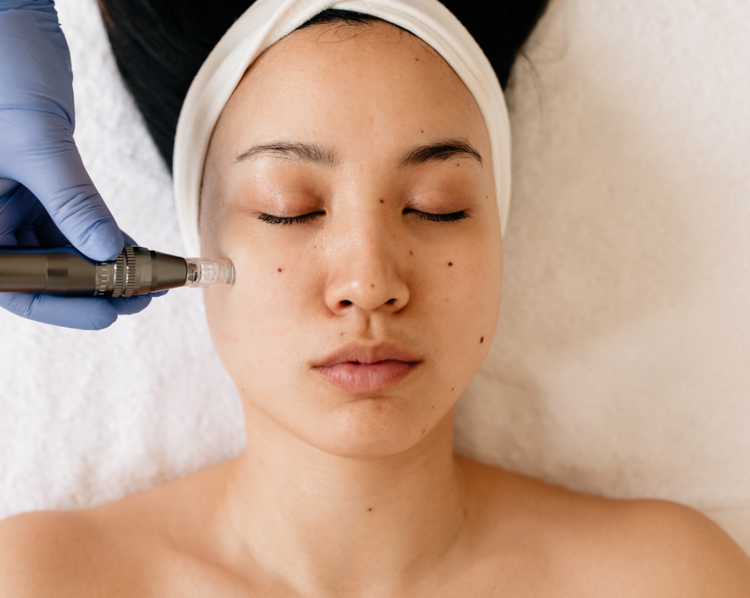
Dermal needling has become one of the cornerstones of modern skin rejuvenation, and for good reason.
Controlled micro-injury triggers the skin’s natural healing response and encourages collagen and elastin production. Depending on the treatment and the skin concern, at Bloom we can use traditional microneedling or RF dermal needling, which combines needling with radiofrequency energy.
It can be particularly useful for concerns such as skin texture, pores, acne scarring, fine lines and loss of firmness.
But the really exciting evolution has been what we can combine with these treatments.
This is where the worlds of microneedling, regenerative aesthetics and advanced Korean and European skincare increasingly meet.
The Korean influence: PDRN and skin regeneration
Korean beauty has had an enormous influence on how we think about skin.
Rather than focusing solely on correcting wrinkles, the Korean approach has long placed importance on hydration, luminosity, skin barrier health and that almost indefinable quality we describe as healthy-looking skin.
At Bloom, our Korean & French skin treatments include a number of treatments inspired by this philosophy.
One ingredient receiving huge attention is PDRN, commonly associated with highly refined salmon-derived DNA fragments used in Korean skincare.
Our PDRN Bio-Meso Facial uses bio-microneedling technology to help deliver active ingredients into the skin without traditional needle puncture, while other Bloom treatments incorporate Salmon DNA/PDRN alongside ingredients such as peptides and hyaluronic acid.
These treatments are designed around hydration, skin texture, resilience and radiance — exactly the qualities at the centre of the current regenerative skin movement.
The Chanel Treatment: a little French influence
Regenerative aesthetics isn’t exclusively Korean.
Our French NCTF 135 “Chanel Treatment” is another example of the move towards treating skin quality rather than simply treating individual lines.
NCTF 135 contains a complex blend of ingredients including hyaluronic acid, vitamins, amino acids, co-enzymes, nucleosides and minerals.
At Bloom, we can combine NCTF 135 with dermal needling or RF dermal needling, allowing us to pair collagen stimulation with an intensive skin-revitalising formulation.
We particularly love this approach for skin that has become dull, dehydrated or less firm with age.
It isn’t about creating a different face.
It is about creating better skin.
And then there are exosomes
If there is one area of regenerative aesthetics generating enormous interest, it is exosomes.
Exosomes are microscopic extracellular vesicles involved in cell-to-cell communication. In simple terms, you can think of them as tiny messengers carrying signals between cells.
Their potential use within regenerative medicine has led to growing interest in their application within aesthetics and skin rejuvenation.
At Bloom, our Exosome Treatment Wellington combines advanced exosome formulations with treatments designed to create the optimal environment for skin renewal.
For us, exosomes represent an exciting extension of something we have believed for years: rather than simply masking the visible signs of ageing, support the processes responsible for healthier-looking skin in the first place.
As with all emerging areas of aesthetics, research continues to evolve, and we believe it is important to distinguish genuine science from hype. Not every new beauty trend deserves a place in a professional clinic.
But regenerative science is an area we are watching closely — and one we find incredibly exciting.
Does this mean the end of “fill and freeze”?
No.
Injectable treatments absolutely have their place, and Bloom offers appearance medicine as part of our wider treatment menu.
But “fill and freeze” has never defined our clinic.
We believe that how your skin looks matters enormously.
You can soften a wrinkle or restore volume, but that doesn’t necessarily address pigmentation, redness, scarring, enlarged pores, dehydration, sun damage or loss of skin quality.
For some people, injectables may form one part of an overall plan. For others, they may not want them at all.
Neither approach is wrong.
The important part is that treatment should be individual.
The future isn’t one miracle treatment
Perhaps the most exciting part of the regenerative movement is the recognition that great skin rarely comes from one treatment.
It is usually a combination.
Laser may address one concern. Dermal needling may stimulate another response. PDRN, NCTF 135 or exosomes may be incorporated when appropriate. LED can support the skin, while good home skincare, daily SPF and lifestyle remain fundamental.
At Bloom, we often describe skin treatment as a journey rather than a quick fix.
And that is perhaps why regenerative aesthetics feels so aligned with our philosophy.
We don’t want every face to look the same.
We don’t believe ageing is something that needs to be erased.
And we certainly don’t believe that every line needs to disappear.
We want your skin to function and look as healthy, strong and radiant as it can — at 30, 40, 50, 60 and beyond.
That, to us, is what modern skin rejuvenation should be about.
Start your skin journey at Bloom
If you’re interested in regenerative aesthetics, dermal needling, laser skin rejuvenation, Korean skin treatments, PDRN, NCTF 135 or exosome treatments in Wellington, our Bloom team can help you work out which approach is appropriate for your skin.
Because the future of aesthetics isn’t necessarily about changing your face.
It may simply be about investing in the skin you’re already in.